
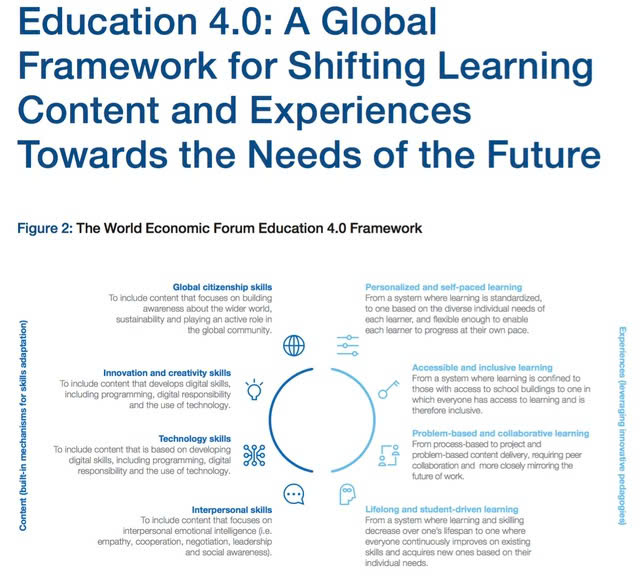
As the 2026-2027 school year begins, VANPPE member preschools have an opportunity to translate the World Economic Forum’s Education 4.0 taxonomy into age-appropriate learning experiences. The WEF framework highlights three broad areas: abilities and skills, attitudes and values, and knowledge and information, with an emphasis on preparing young learners for future economies and lifelong well-being (World Economic Forum).
For preschool children, Education 4.0 does not mean teaching advanced technology. It means creating more opportunities to explore, create, communicate, collaborate and solve problems. VANPPE members can incorporate these principles through hands-on STEM activities: children can observe a problem, propose ideas, build simple solutions, test them, and learn from failure. KidsEdu STEM program provides a practical example, combining preschool STEM with computational thinking, creativity and problem-solving, while its Robotics activities allow children to experiment with construction, sequencing, sensors and simple programming concepts.
Technology should remain a tool for human-centered pedagogy, rather than an end in itself. Robotics, AR/VR and digital resources can make abstract concepts more tangible, while teachers remain central in guiding questioning, discussion and collaboration. This approach is consistent with the WEF’s broader emphasis on learner-centered education and its view that technology should enhance – not replace – human-led teaching.For the school year 2026-2027, VANPPE members could therefore set practical goals such as one STEM/Robotics project per month, structured opportunities for teamwork and communication, and teacher professional development in inquiry-based learning.
Learn more about the World Eonomic Forum’s Education 4.0 Taxonomy: https://www3.weforum.org/docs/WEF_Defining_Education_4.0_2023.pdf
